
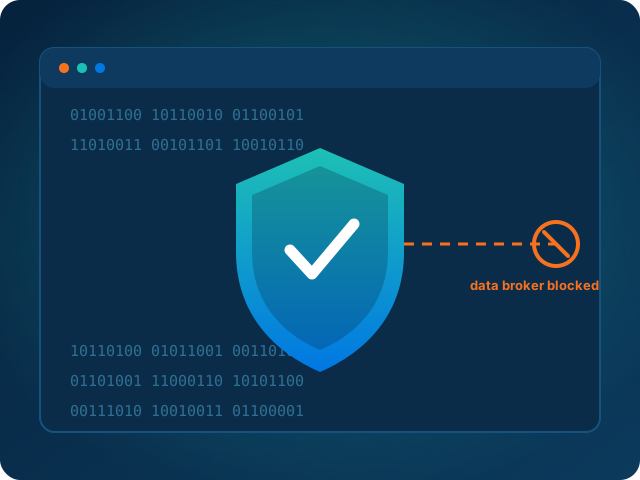
This isn’t a story about a single confirmed campaign or a smoking-gun data breach. It’s about an architectural shift — a change in how tracking code can be packaged that, if it spreads, makes the old way of fighting back far less effective. Worth understanding precisely, then, before it becomes the default rather than the experiment.
When the code stopped being readable
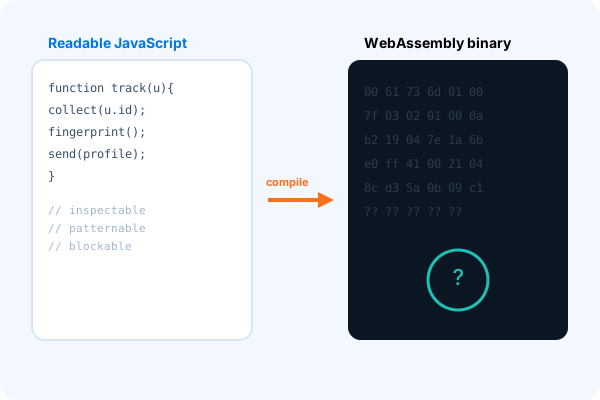
JavaScript has always been the engine of web tracking, and JavaScript has one feature that mattered enormously for privacy: it’s human-readable by design. Even when a data broker minified a script into a dense wall of characters or ran it through an obfuscator, the result was still text that could be untangled. A determined researcher could trace the functions, spot the ones built to harvest your data, and write a precise rule to neutralise them. The cat-and-mouse game was real, but at least both animals could see each other.
WebAssembly changes the lighting in the room. When tracking logic gets compiled into a Wasm module, it stops arriving as text you can inspect and starts arriving as a binary — a block of machine-level instructions meant for the browser to execute, not for a person to read. The thing you’d want to examine simply isn’t legible anymore. That’s the shift worth paying attention to in 2026, and it’s why this deserves a clear explanation rather than a panic.
What the “black box” actually is
It’s important to be fair to WebAssembly, because it isn’t malware and was never intended as one. Wasm is a genuinely impressive piece of engineering — a binary instruction format that lets browsers run heavy, complex applications at speeds close to native software. Think 3D rendering, video editing in a browser tab, games that would have been unthinkable a decade ago. The performance is the point, and the technology is legitimate and widely useful.
The uncomfortable part is that the qualities making Wasm excellent for legitimate apps also make it appealing for hidden tracking. The same opacity that protects a company’s proprietary rendering engine could just as easily shield profiling logic from scrutiny.
Here’s the practical picture. Rather than serving a readable JavaScript file, a page can hand your browser a compiled binary “blob” and tell it to run. To you, nothing looks unusual. Under the surface, your browser is executing instructions you can’t see into, with no obvious way to know what they’re computing. The browser stops being a transparent platform you can audit and becomes a host for code that runs in the dark. That’s the loophole — not a flaw in Wasm itself, but the way its design happens to frustrate inspection.
Why your current ad blocker may not see it
To understand the risk, you have to understand how most privacy extensions actually work. The common approach is static analysis: the tool scans a page’s code looking for recognisable patterns — known tracking signatures, suspicious variable names, the telltale shapes of data-harvesting behaviour. It’s pattern-matching against text, and it works because, historically, the text was there to match.
Compile that same tracker into WebAssembly and the patterns vanish. The recognisable function names, the familiar code structures, the signatures a blocklist was tuned to catch — all of it collapses into raw binary that bears no textual resemblance to what the blocker expects. There’s nothing left for the scanner to recognise.
A legacy blocker shrugs, classifies the Wasm module as just another complex page asset, and lets it through — not because the tool failed at its job, but because the job quietly changed underneath it.
Could a blocker decompile the binary on the fly and analyse it in real time? In theory. In practice, that kind of live disassembly is brutally expensive — the sort of thing that would bog your browser down noticeably on every page load. So the realistic outcome is that the module passes through unexamined.
More than hiding: the performance dividend
Concealment is only half of what Wasm offers a tracker. The other half is horsepower, and this is where the architectural risk gets sharper.
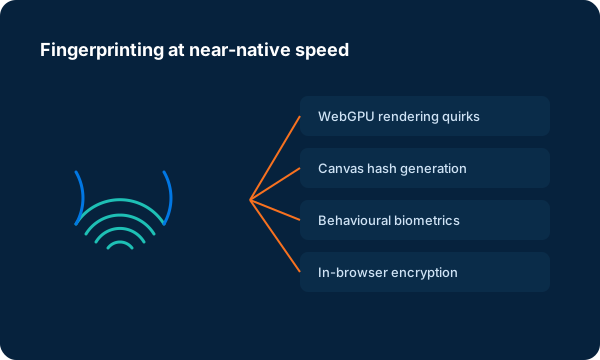
Some of the most invasive fingerprinting techniques are computationally demanding. Pulling a detailed hardware fingerprint — probing WebGPU rendering quirks, generating complex canvas hashes, crunching the motion data behind behavioural biometrics — takes real processing muscle. JavaScript can do these things, but Wasm can do them dramatically faster, running heavy calculations locally on your device in a blink. A tracker that was once too sluggish to be practical becomes fast enough to run unnoticed.
There’s a second, subtler use worth flagging. Because Wasm handles intensive computation so efficiently, it can perform serious cryptographic work right inside your browser — including encrypting a profile before it’s ever transmitted. The consequence is pointed: by the time the data leaves your device, it may already be wrapped in strong encryption. Even a privacy tool that manages to catch the outbound request can’t read what’s inside it. The payload is sealed before it crosses the wire.
We’d stress that this describes capability, not a documented epidemic. The point isn’t that every site is doing this today. It’s that the building blocks — invisibility plus speed plus in-browser encryption — fit together unusually well, and that combination is what makes the architecture worth taking seriously now rather than later.
The defence that doesn’t depend on reading the code
If you can’t inspect a black box, the instinct to analyse your way out is a dead end. But analysis was never the only option — and here the problem contains its own solution.
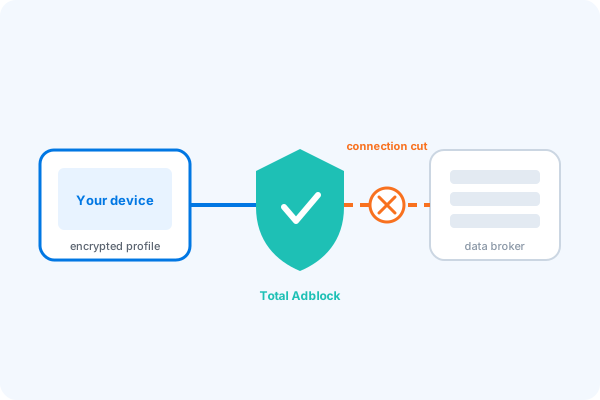
A tracker that hides perfectly and encrypts flawlessly still has one unavoidable requirement: it has to phone home. All that locally computed, neatly encrypted profile data is worthless to a data broker until it reaches the broker’s server. The exfiltration step can’t be hidden inside a binary, because it’s a network event — a connection leaving your device for a destination out on the internet. That connection is visible no matter how opaque the code that created it.
This is the layer Total Adblock works on. Rather than trying to decompile binary modules — a losing race on performance grounds — it focuses on network-level filtering and API interception, watching the structural outbound requests your browser tries to make. When a request heads for a known telemetry endpoint or data-broker server, that connection gets cut.
The elegance is that encryption stops mattering. It doesn’t matter how thoroughly a Wasm module scrambled your fingerprint if the scrambled package never reaches anyone. Block the destination and the data is trapped on your own machine — computed, perhaps, but undeliverable and therefore useless. You sidestep the unreadable code entirely by refusing it the one thing it can’t do without: a way out.
And because the intervention targets tracking endpoints rather than the legitimate Wasm powering the apps you actually use, the genuine performance benefits of WebAssembly — the games, the editors, the fast in-browser tools — keep working as intended.
Closing the exit, not the box
The move toward binary tracking is a real shift in the terrain, even if it’s still early. It quietly retires the assumption that privacy depends on reading code, because increasingly you won’t be able to. What it can’t retire is the simpler truth underneath all surveillance: stolen data only has value once it’s delivered. Cut the delivery, and the cleverest hidden tracker becomes an expensive way to compute a number that goes nowhere.
You don’t need to crack open the black box to defeat it. You need to close the door it’s trying to leave through. Let Total Adblock guard that door — and keep what your browser computes from ever reaching the people who want to sell it.